23 eggs and 12 embryos later

I am basically a human farm animal.

My IVF cocktail of Lupron, Follistim and Menopur worked so well that, even though the growing took the full 12 nights, my doctors were able to retrieve 23 eggs from my incredibly swollen ovaries. The last few injections had become uncomfortable, for sure, but I was anticipating that the discomfort would subside not long after the retrieval procedure.

Nope.

While getting 23 eggs was incredibly successful by any measure, the discomfort was really just beginning. Apparently it’s pretty uncommon, but the days following my retrieval were very painful. Aside from the normal bloating going into it, the bloating became worse and was accompanied by shooting pains in my lower abdomen basically any time I moved. My retrieval was on Friday, and by Saturday night — feeling worse than I had the previous day (shout out to my anesthesia for keeping me fairly out of it!) — I emailed my nurse to say “the good news is that the lab called and said we have THIRTEEN embryos that have fertilized and appear normal, but the bad news is I feel like someone tried to gut me like a fish, but failed.”

I’m not a religious person, but IVF nurses are angels and should be carried around by stunning shirtless men (or women, if they prefer) while being fed grapes. I’ve only known my IVF nurse for about six weeks but I trust her more than I do some of my own family members. She is, no lie, one of the best people I’ve ever met, and regardless of what happens next, I am so grateful for her help and encouragement in my life. Thank you.

5e48297f1672eb73f60307bd0c15ad87

#IVFnursesFTW

After spending the weekend almost exclusively in bed with varying degrees of pain, I was called back to the doctor today to ensure that nothing was wrong, since it’s abnormal to still be experiencing discomfort several days after retrieval. The very straight forward doc that I’ve seen only once before checked me out, while noting that I am not one of those annoying patients that complains about everything. With help of the ultrasound, he said that my left ovary was “enormous,” and would most certainly be the cause of most of the discomfort. I also had some fluid behind my uterus, but not enough to cause for concern. Non-medically speaking this means that my ovary is saying, “WTF did you do to me?!” and is seriously pissed. Not that I blame her.

tumblr_n3h4veqboo1toamj8o4_500

My left ovary has gone all Dark Willow on me.

In much more positive news, I am the very lucky winner of TWELVE “good” embryos! #13 is lagging behind a bit, but still of the “fair” camp. Despite leading with what a crappy retrieval experience I’ve had physically, I am thrilled that, if I had any desire to, I could make a football team with these little guys (or girls). While I don’t have any intention of creating a family of Duggars, it makes me feel quite positive that the embryologist will have lots of squirmy cell clusters from which to choose the best one. YAY 12!!

My transfer is scheduled for Wednesday. To be continued…
An unlucky sisterhood

I’ve found at times that it can be difficult to talk to other women about infertility who have never experienced it. They got pregnant quickly or easily. Perhaps accidentally. If you watch their faces as you tell your story of waiting, loss, pain and aching, you might see a small flash of relief that they didn’t have to experience what you do. I’d probably have it, too. It’s not hurtful to me because I completely get it.

Just as often their faces show compassion and genuine sadness for your story. They shake their heads in empathy. A lot of women I’ve spoken to choose their next words carefully, which I appreciate. If you haven’t been through this, please don’t tell me that everything happens for a reason or that we’re not given more than we can handle. You may believe those things, and that’s fine. But I don’t. Not now. Maybe I never did. It doesn’t mean I’ve lost faith; it just means that those words have little comfort for me, and many other women experiencing infertility.

Those of us in this unlucky sisterhood have been burned. I choose the word unlucky here merely to illustrate that there’s often no rhyme or reason for our infertility. I check out fine, as does my husband. I don’t necessarily think “luck” in the traditional sense of the word has anything to do with it; but here we are, together, maybe huddled in the corner of impending parenthood, trying to make sense of what we have to deal with.

In this sisterhood many of us are guarded and know the value of choosing our words carefully. We know that a positive pregnancy test can mean hold our breath during the entire first trimester. Our “I’m pregnant” is often followed by “I hope this sticks.” Unless you’ve said aloud or thought that phrase in context, you can’t really understand the gravity of it. Many couples will never know what it feels like to be both happy and completely unsure if that joy will change on a dime. What placing a bet of thousands of hard-earned dollars down of hormones and ultrasounds will get us. Going all-in to nurse an infant at 3am. To be a human pin cushion and relying on science to see our eyes or our spouses looking back at us from the safety of our cradling arms.

I recently had conversation with a fellow sister who told me of another who’d been rejected as a prenatal patient by an OB because she “wasn’t excited enough about her pregnancy.” In hearing this story, I was shocked that a doctor — an obstetrician, no less — could be so unfeeling toward a woman who’d had a tumultuous time even getting to the point of needing an OB. Clearly that would not have been a good patient-provider fit, but it hurts my heart that a fellow unlucky sister had to hear that from a professional.

The women that I know who are experiencing this with me are so strong, so fierce and so very deserving. I feel connected to this vast network of women that are every shape, size, color… I never wanted to join this unlucky sisterhood, but I’m here now, and sending support from the very bottom of my heart. We can do this.

Lupron: Day 8

Last night, I woke up four times to pee. I’m a light sleeper with a small bladder, but that’s a lot even for me. “Increased urination at night” is a pretty common side effect of Lupron, apparently. As is fatigue, which the struggle is very real right now. I’ve also started to bruise a bit at the injection sites on my tummy. Totally expected, of course. I joked with my mother, who is visiting us next week, that my stomach will look like a Rorschach test by then.

Ready or not

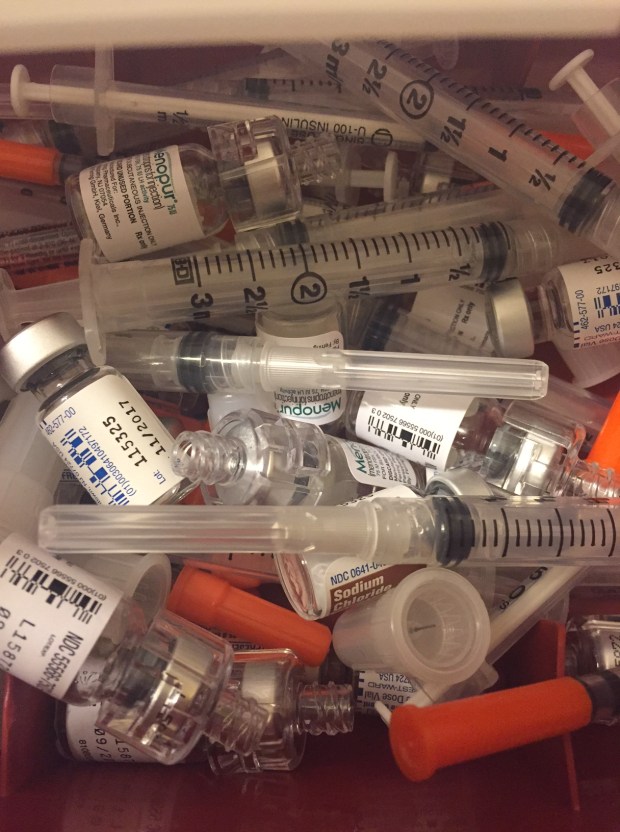
When a giant, heavy box arrives at your front door at 9am on a Saturday morning, you want it to be a present. At least I do. Instead, it’s a box packed tight with syringes, injectable medications and alcohol wipes. I can hope that the sharp objects and hormones will bring me closer to the present I actually want. (Hint: a baby)

Youcandothis. Youcandothis. Youcandothis.

Money, money, money

In news that will surprise no one that has undergone fertility treatments, they are expensive. While planning for my upcoming IVF cycle, today I found out that the cost to genetically test our embryos was out of our range. I’d thought, perhaps naively so, that cost was already included in what I’d paid out of pocket.

Before I explain/complain about that, I will say that I am remarkably lucky in that my health insurance plan through my employer is very generous to cover a lot of my treatment. My company values family and that extends to health care for infertility, paid time off and other family-expansion options like adoption assistance. I know I am lucky. Having said that, I am still relatively new to the company, so these incredible benefits are new to me, too. My last health insurance provider (a policy that I shared through my husband’s employer) didn’t cover any fertility options, so our first year of treatment was paid entirely out of pocket. Four IUI cycles, meds, labs, ultrasounds, a D&C… the list goes on. It added up quickly, as any couple in a similar situation knows well. Much of my “disposable” income last year went somehow to my fertility doctor inserting something into my vagina.

16mb0

Now, with new (superior) coverage and another failed pregnancy behind me, we decided to take things up a notch with IVF. The new plan with my doctor includes what could be referred to as the “base model.” Standards labs and medical screenings pre-IVF, a brief class on how to inject the required medications (note: not the medications themselves, they are separate), monitoring, egg retrieval, egg insemination (half traditional and half ICSI) and embryo transfer. But because the cause of my first miscarriage was a chromosomal abnormality, we were advised (and agreed) to perform genetic testing on the embryos prior to transfer. This bonus feature helped me to alleviate some of the anxiety I feel about trying IVF, primarily in that we would be essentially guaranteed a viable embryo would be transferred. After two miscarriages, a little security felt necessary.

Today, though, I was informed that my insurance, generous as it may be, does not cover this screening and is, therefore, off the table. You know how in old cartoons characters’ eyes will bug out? That was me about an hour ago.

Financially speaking, the added cost of this is totally reasonable to pay out of pocket for a lot of people (I’d imagine). But, for a couple that lives paycheck to paycheck (and whose savings had previously gone to non-covered attempts to get pregnant), it is out of reach to afford it after the out of pocket cost of the base model, plus required medications. And for as lucky as I feel to even be able to do IVF (it would have been financially impossible for us without the added assistance of my company’s insurance), I still want to scream that I’m not someone who can get pregnant without medical intervention — the “free” way, as I often refer to it. While fertility clinics will likely be the reason I one day have a baby, they are an absurd money drain sometimes.

The removal of that genetic testing safety net is quite a disappointment, but, as my optimistic husband reminds me, not insurmountable. Without the testing, the embryos can be transferred shortly after their insemination, and not having to wait until the following cycle. So, perk there. And I trust that the team of professionals handling my tiny future children will use their best judgement and experience in choosing the lucky one that will meet my uterus. All my dolla bills (not to mention my hopes and dreams…) are counting on them.


gif by popkey.co

One step forward, two steps back

It’s been just more than seven weeks since I miscarried and they’ve crawled by at a snail’s pace. I didn’t put any expectations on myself to feel better, physically or mentally, in any finite amount of time.

Emotionally some days are better than others. That’s often how grief works.

Physically has been a series of ant hills and mountains. Since I did not miscarry naturally, I assumed the recovery period would be pretty limited. My doctor, who also performed the D&C surgery, told me to expect some heavy bleeding and cramping for a few days, and mentioned to be aware of fevers or other unexpected changes. After a little more than a week, I was feeling more like my pre-pregnancy self. I was tested to ensure that my hormone levels were dropping appropriately, and it was confirmed that they were. After another follow-up, my doctor cleared my husband and I to try again following my next period. She expected that I would see that unwanted, old friend again within about four weeks, perhaps six.

I’m not sure why I thought my body would adhere to the normal timeline — considering that my infertility is largely unexplained — but as I passed weeks four, five, and six without a period I wondered if things were okay. I was feeling fine physically, so what was going on? I consulted Dr. Google (which, really, why do I ever do that?) and fell down a Babycenter rabbit hole. More than two-thirds of the women posting in the thread about post-miscarriage menstruation said they’d actually discovered that they’d almost immediately gotten pregnant again. Reading this, of course, gave me some hope. I mean, this was a lot of women who said this happened.

I even took a pregnancy test on my husband’s birthday thinking wellll… Negative.

Every time I’m tempted to ask myself why not me?, I just stop. Because I’m not those other women. I really never am. None of this has gone my way. I’m more like the one woman who posted that she was 13 weeks post and her hormone levels were still high and no red in sight. Ugh.

This week, though, I’m bleeding like a stuck pig.

Asking why not me? always ends in tears and frustration. This hasn’t been easy. In fact, it sucks. Today I’m feeling a little tired of pretending that it doesn’t. There’s not a handbook for it. I’m writing my own.

Treating my whole self

I’ve struggled with depression and anxiety for many years. Because of this, and the help I’ve asked for in getting through some of the most difficult times, I’ve been in therapy pretty consistently since I was 22 years old. I strongly believe that this, paired with a cocktail of antidepressants, have allowed me to be a (mostly) normal, functional human. They’ve also kept me from slipping farther into the black hole that depression can crate. In a lot of ways, a combination of therapy and medication has kept me alive.

Like with any subject, there are people on the other side of the fence that believe that depression and anxiety can be controlled without therapy or medication; some may even say that “it is all in your head.” I’m not here to change their minds.

One of the most challenging things about infertility is managing the flood of emotions that come with the highs and lows of the experience. I’m no stranger to recognizing my own triggers for depression and anxiety, so I’ve tried to stay on top of coping with my emotions. That is, of course, when I can even process them. Occasionally it feels like everything I’m feeling — particularly since my miscarriage — gets stuffed into a cheese cloth and then wrung out when I least expect it. At the height of some of my worst months of previous depression, the feeling was very much the same. Some of what is in the cheese cloth remains, but much is coming out in a steady stream of everything inside. It’s hard to plan for what often comes out unexpectedly.

This weekend The New York Times Magazine ran a piece that hit close to home — “The Secret Sadness of Pregnancy with Depression.” It’s a tremendous, eye-opening read that focuses on antenatal depression (depression while pregnant) and how serious of a condition this can be, particularly if left untreated.

The article comments:

“Though antenatal and postpartum depression are linked, antenatal depression has remained underground. Much of the stigma around maternal depression — antenatal and postpartum — seems to focus on women who fail at joy, often suggesting that such women are heartless. How can anyone not be swept up by the momentousness of producing a child who will give her life purpose? The myth of the pregnant mother who is high on hormones has had considerable staying power.”

The emotional needs of the soon-to-be mother are too often ignored and pushed aside. Even the healthiest of pregnancies is still an insane journey of physical and emotional stress on a woman.

This piece reminded me why I recently decided to find a new therapist and spend that hour a week examining everything that I’m feeling now, and have felt in these two-plus years of trying to conceive a baby. Returning to treatment means taking the bull by the horns and owning that what I’m going through is enormously stressful and emotional as hell. I’ve never been one to take for granted what it can mean to have a clear head, and I’m certainly not ashamed to say I need some help getting there.

I’m listening

Probably one of the most important lessons I’ve learned about fertility over the last two-plus years is to listen to my body. Only a few years ago I likely would have thought this concept to be too new-agey for me, and in a way, it is. But when your month, every month, consists of testing things, prodding and then waiting, it’s natural to become hyper-aware of your body.

My husband and I tried to conceive naturally for nearly two years before we sought assistance. I was pretty well convinced when we first starting fertility testing that the doctors would find something wrong with me. Somewhere, in the back of my mind, I knew that to be true. Early on in that process, we got some mixed results which had be concerned. These red flags all but convinced me that I was right. I was so very thankful to be wrong. The red flags largely turned out to be caused by ultrasound shadows. By the time sat down with our fertility doc, our infertility was unexplained. My husband and I fell into that mysterious 10-15% of couples where there’s no discernible cause to have not conceived naturally in two years.

Less than a week after meeting with our doctor, we began the Clomid + IUI plan that we’re currently on. A friend of mine, when I mentioned that course of treatment mentioned that Clomid didn’t work for her, and she felt strongly about that very early on. She heeded, “listen to your body.” It’s great advice, and words I paid attention to.

In our most recent Clomid + IUI cycle, my OPKs never picked up an LH surge (this had also happened the previous month, and I missed the window for IUI because I never saw a positive OPK). But, I had all of my typical ovulation symptoms. Over the course of about 18 hours, I went back and forth with the incredible staff of nurses that I work with at our clinic, along with my husband, to decide if we should proceed with this month’s IUI. There are always a lot of factors to consider in fertility treatments, and, too often, cost is a major one. Our medical insurance does not cover fertility treatments, so we’ve paid for our visits and procedures over the last several months out of pocket. This cost is significant to any couple that doesn’t have a hefty savings to fall back on, as it has been for us.

So, a serious concern in deciding to move forward with this IUI was, obviously, cost. Without an LH surge detected, I had no firm indicator that I’d ovulated. It was more of a risk to decide to move forward with an IUI (and timing it, essentially, blind). I listened to the advice of the nurses that have gotten to know me, and that of my husband (who, ultimately said, “uh, I don’t know…”). And then I listened to my body. My body said, in her sassy way, “girl, you’re trippin’… you ovulating! Go make that baby!”

I’m happy that I listened, no matter the outcome. For now, though, to be continued….

Fatty McButterpants

I have a brother eight years younger than I… we’re the best of friends, and I really helped to raise him. He’s now an amazing, hard-working man that I am very proud to call my brother and my friend. When he was about eight years old, he started to put on some weight. This continued for a few years, and then he got into weight-lifting as a teenager. He got ripped. Still is. He’s won many weight-lifting competitions. When we look back at old photos of his awkward years, we call him “Fatty McButterpants.”

As a kid, I was the opposite. I was very active as a cheerleader (I can hardly even believe that now!) — jumping, tumbling, lifting and whatnot — and was always a thin, healthy size for my small stature (I’m 5’2″). Then college happened, I discovered gourmet cupcakes and binge-watching DVDs, and the rest is history. Gone were my days of size fours.

I’m a big believer (pun intended) in ending the era of fat-shaming (one of my favorite bloggers, Brittany Gibbons, is an incredible advocate and a daily inspiration in reminding me my weight isn’t going to stop me from doing awesome things). Trying on a bathing suit is likely to send me to cry on the floor of my closet with a half-gallon of cookies and cream ice cream. I’m absolutely an emotional eater. My scale fluctuates depending on my stress level and if I’ve discovered a new flavor of pop-tarts.

I’ve asked my fertility doctor if my weight is negatively affecting my ability to conceive. She says it’s not (other than a low thyroid issue that I’m also on meds for). But there’s a lot of information out there that says it could be. My focus, especially since we started trying to have a baby, has been getting healthier, making better choices. Only spending half of my Saturday binging on Netflix and the other half taking my dog for a walk or heading to the gym. Eating a banana or a protein bar when 3:00 hits instead of driving to Duck Donuts. I succeed in this about half of the time. I admit I have a lot of work to do.

What has caught me off-guard, though, has been my weight gain on Clomid. While it may be working great in helping my body produce healthy round follicles, I’ve noticed in the last few weeks that it’s causing some roundness in other places too. Probably seven or eight pounds of round. Which means my pants no fit.

Other than the unfair pregnancy-like symptoms I’ve written about before, I thought I’d been experiencing Clomid relatively unscathed. One hears so many horror stories, after all. But now that I’m smack in the middle of month four, it’s become clear there’s some scathing. Another eight pounds on an already Umpaloompa-ish body is not cute. Particularly as swimsuit season approaches here in the South.

It’s difficult to rectify the feelings I have about weight gain with knowing that it’s caused for a “good reason.” I worry about how much harder it will be to take the weight off postpartum, when there’s a lot less time to think about being active and not grabbing for the Oreos, because, ya know, I’m then responsible for an infant. That’s going to be rough…

I pretty much just fat-shamed myself, huh?

Image from Amazon.com